Posts

27/10, 28/10 - Analysis and Design

Image
            This week was all about analysis and design thinking. The first class of the week began with a group activity. We were asked to divide into pairs and read two drafts of an argumentative essay. We were then asked to critically analyse and note our opinions. This activity was mind-numbing at the beginning because the essay was terrible, even by my standards. But analysing and criticising the essay with my partner, Ritorni Dutta, was quite engaging. Nikhil Sir then asked us to draw a caricature of each other. I am not an artist in any shape or form, so naturally, the drawing did not turn out well. Nikhil Sir then went on to explain that creativity was inherent. I still haven't found enough creativity in me to believe that but I hope I will be proved wrong. He also explained design thinking and its components.            The next class took off in the art sector again. Nikhil sir gave us a series of keywords a...

20/10, 21/10 - Reviewing Friends and Sample Essay Critiques

Image
This week was all about reviews. The first class of the week had us in partner activity. Nikhil Sir asked us to split into pairs, read each other's multimodal essays and write a review on them. He also provided an extensive rubric for us to follow, complete with his signature memes.  I partnered with Silka Jayapadme, who had written her essay on the topic Should India Have A National Language? . I was pretty impressed with the way she had written and handled the concept of multimodality in her essay, as I made clear in my review. Her multimodal additions were also very interesting and added to the information in her essay. The activity prompted me to critically examine an essay and carefully analyse the conception and thought process that goes into an essay and how it translates to the reader.  The next class went along the same vein. We tried to concentrate more on critically analysing what makes a good argumentative essay. Nikhil Sir provided us with an explanation of what a...

13/10, 14/10 - They Say, I Say and Multimodality, Intermodality

Image
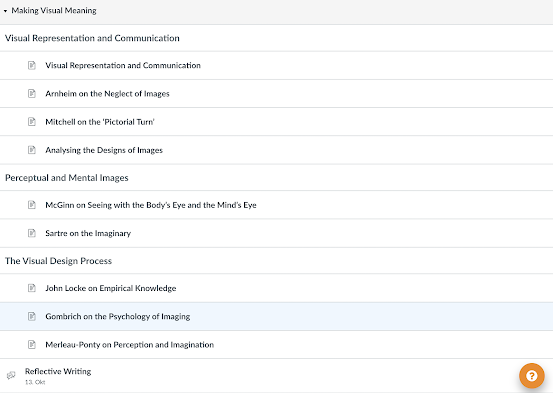
  This was quite a week. It began with a reflective writing assignment. We were required to read a module on Visual Meaning Making and write a reflection on it with particular emphasis on Visual Representation and Communication, Perceptual and Mental Images and the Visual Design Process. Reading the material, in all honesty, was an ordeal. Most of the sections were very long-winded and I could not make sense of a lot of them. The texts were also blatantly un-visual for a module on making visual meaning. Quite frankly, I did not enjoy reading them. We also had to make our first argumentative essays multimodal and improve it in any way we feel suitable.  The first class started off on this note. I was a bit relieved to find out that it was not just me who had a problem with the essays. Comprehension was hard for almost everyone. We requested more time for the assignment which we did get. We then moved on to discussing writing styles in academic essays. We talked about the concep...

06/10, 07/10 - Multiliteracies and Quotation Sandwiches

Image
  This week's classes focussed on multiliteracies. Multiliteracy refers to understanding and manipulating various individual modes to suit one's needs.  Multiliteracy is important in any kind of sphere in today's world. We began the discussion with a bit of history - how academic communities like the New London Group envisioned a shift in the modes of education and how it unfolded. We then moved on to how multiliteracy works and how we can use it ourselves. We also learned that there is a specific 'grammar' for multiliteracies which revolves around its reference, agency, structure, context and interest. Further, we briefly discussed how to correctly quote points while citing an article or author. We went back to our previous classwork essay on two-hour classes and quoted a source in it. This exercise was good practice in how to correctly execute the 'sandwich method' of quoting i.e. introducing the quote, actually quoting it, and then backing it up and expla...

29/09, 30/09 - On-The-Spot Essays and Multimodal Posters

Image
 This week took us back to quite a few previous sessions. The first class of the week took us through constructing an argumentative essay. Nikhil Sir reiterated the five aspects essential to an academic essay's structure - introduction, arguments, counterarguments, qualifiers and conclusions. This took me back to my own previous attempt at writing an argumentative essay. We were then asked to write an argumentative essay in class on the topic 'Are Two-Hour Classes Necessary?'. We got into pairs and discussed possible arguments, evidence and counter-arguments. We went through all the processes of writing an essay, from brainstorming, to free-writing, to editing. We also read each other's essays and gave peer feedback.  The next class was a showcase of our multimodal posters. We made our multimodal poster with inspiration from our previous poster on Canva and iMovie. We used visual, aural and linguistic modes on our poster. We added a newspaper article about the Kerala fl...

22/08, 23/08 - Multimodality Jargon and Saving Ideas from being Stolen

Image
This week began with a reiteration of multimodality. We were required to choose a multimodal text and analyse how its multimodality adds to the message it hopes to convey. I decided to use two multimodal texts - an advertisement for  StayUncle and a meme about a Kpop band, Stray Kids.  I chose to analyse this advertisement because of the social relevance and inclusivity it portrayed. It was also interesting in terms of its multimodality - the advertisement featured only a simple blurred background and a caption, but the details made its message of it very clear and powerful. The company's subtle approach to this topic is perfectly done.  I was particularly struck by how much the visual and spatial elements of the advertisement added to the linguistic facet of it. The gestures in the image were also detrimental to getting the point of the advertisement across. The multimodality in the text, hence, makes it more effective than a simple linguistic write-up.   ...

15/09, 16/09 - Peer Reviews and Multimodal Writing

Image
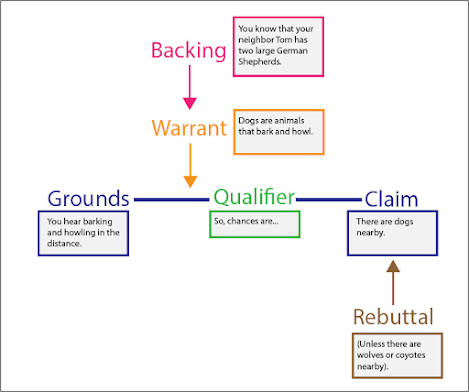
  This week was about structures in academic writing. We had already written an essay with our limited knowledge of writing practices in academic writing. This week focused on making writing better and more interactive.   The first class took us back to our first attempt at writing an academic essay. Nikhil Sir recapped the Ethos, Pathos and Logos lesson before introducing the concept of Toulmin arguments. There is no concrete formula to writing academic essays - all of these concepts exist to make the process of essay writing easier. We then split into groups based on linguistic categories - I was put into a group with three other Malayalam speakers. We were asked to review each others' essays and provide feedback on the same. The feedback I got from my peer group was invaluable and gave me many ideas I could implement to improve my essay. We were also joined by two other research scholars, Prashant Sir and Chelsea ma'am. Chelsea ma'am spent time with our team and was ve...

08/09 - Persuasion and Brainstorming

Image
Rhetoric is the art of effective and persuasive speaking. Alongside grammar and logic, it makes up the three ancient arts of discourse. Rhetoric is important in any kind of discourse; so that is what we tackled in this week's session.  This week's class started with the discussion of Aristotle's three modes of persuasion - ethos (credibility), pathos (emotion) and logos (logic). These three modes are paramount in speaking persuasively. With Nikhil Sir, we evaluated its applications in writing, which, in its own way, aims at persuasion. We also discussed real-world examples of these concepts and which aspect of persuasion they tend to lean on more. Emotion seemed to be a very important aspect of many famous speeches - Mark Anthony's speech after the assassination of Julius Caesar, and Martin Luther King's famous speech, 'I Have a Dream', all employ Pathos to sway people. Citing and discussing these examples was a good exercise and it allowed me to analyse wha...

08/09: Argumentative Essay #1 - Should India Have A National Language?

Image
Should India Have A National Language? The matter of deciding on a national language is a very long debate in India. Hindi is heralded as the de facto national language (Chand, 2011), in complete disregard of the fact that India is a country with diverse linguistic communities. India having a national language would be against the essential values the Indian Constitution was built upon. The question as to whether India should have a national language has one logical answer; India’s cultural complexity is such that it would be wildly unfair to reduce it under the banner of one national language.  The Eighth Schedule of the Indian Constitution currently lists twenty-two constitutionally recognised scheduled languages as being the official languages of the Republic of India ( Eighth Schedule to the Constitution of India , n.d.). There are demands to add about 38 more languages spoken in India ( Constitutional Provisions Relating to the Eighth Schedule , n.d.). Hindi and English ar...

25/08, 26/08 Part #2: 26/08 - Team Work and Presentations

Image
  This  class was a culmination of a week's worth of work. We were asked to split into teams and present a poster on any academic text, paying special attention to the elements of academic writing that we learned in the past few classes. I was in a team with four of my classmates - Abhay Krishnan, Dolaram Surya, Keerthi Vardhan Reddy and Likhitha Kavuru. The poster we came up with was a reflection of the time and work we put into it.   We started by trying to find an article we could use for our poster. We looked up countless academic texts on the internet, but most of them were too complex and long-winded for us to use. We finally fixed on a research essay from the IMPACT journal -  The Devastating Kerala Flood - 2018 And Its Impact On Market Trends In Consumer Durables In Kottayam  by Rani M. Susan. We chose this essay because it used simple language and had a clear demarcation of elements. The next issue we faced was setting up a meeting at everyone's co...

01/09, 02/09 - Why Plagiarism is a No-go and How To Avoid It

Image
  Plagiarism is a cardinal sin in academic writing. It is absolutely unforgivable in academia to the extent that even one instance of plagiarism in an academic work by anyone can lead to the perpetrator losing all credibility and respect of others. This week's class was about how plagiarism happens and how we can avoid it.  Nikhil sir took us through the various kinds of plagiarism there is. He explained in detail what constitutes plagiarism. He also took us through how one can avoid plagiarism in essays. The two major ways he stressed are paraphrasing and citations. We learned the different ways of paraphrasing paragraphs and did worksheets to better understand them. This helped me understand how exactly one should paraphrase any kind of content.  Any discussion on plagiarism and the like inevitably leads to the question of ethics. Paraphrasing if done right can get one out of plagiarism accusations, but one is ethically obliged to show sources if they are ideas taken fr...

25/08, 26/08 Part #1: 25/08 - Detective With Essays

Image
This week began with a class from Sonali Ma'am. She went deeper into the classification of essays and taught us how to deconstruct essays into graphic organisers to simplify them. Making graphic organisers for essays helped me analyse the structure and function of specific types of essays. She also got us to do worksheets where we classified and deconstructed essays into pre-made graphic organisers. We also made our own organisers for sample texts, which was surprisingly a very stimulating exercise.  This session was a hands-on learning experience. I learned how to map out an essay to figure out exactly what the essay needed. This is also great practice for writing future essays. Making graphic organisers before getting into writing an actual essay is a very efficient method to ensure that one's essay is driven forward in the way that it should be. It would also help prevent redundancy to an extent. The session provided very valuable insights to my academic writing perspective.

18/08, 19/08 - Thesis Statements, Essays and Abstracts

Image
  This week was all about what makes a good essay. Essays are essential in academic writing, so there is no question regarding the importance of learning how to write a good essay when it comes to a class like this. The first class of the week started with a fundamental part of any essay - the thesis statement. The thesis statement conveys the controlling idea of an essay. Nikhil Sir took us through what encompasses a thesis statement in an essay, the parts of a thesis statement and the do’s and don’t associated with it. He followed up the explanations with a Padlet activity where we tried to identify the elements of a few sample thesis sentences.The activity helped solidify my understanding of the concept. We ended the class with a group assignment to analyse any academic write-up of our choice and identify academic writing elements in the essay using what we have learned. The second class of the week was taken by Betty Ma'am. She took us through the genres of academic writing, w...

11/08, 12/08 - Introducing Writing In Academia

Image
     Academic writing had always seemed dauntingly boring to a person like myself, who thrives on witty retorts and creativity. Which is probably why the first phrase that stuck with me from all the academic writing sessions I went to was that academic writing doesn't have to be boring, theory forward text pieces. Of course, this does not mean that academic writing suddenly becomes a haven devoid of rules. Nevertheless, it is quite possible to be interesting while keeping one's controlling idea in mind.  Rules are paramount, especially when it comes to a concept of the likes of academic writing, which is expected to be uniform and concise. The very first class was relevant in this respect. It took us through the framework of academic texts and what drives an academic perspective forward. We also paid particular attention to the various divisions that makes a text distinct. It was interesting to consider that an academically inclined text could take multiple paths and...